Thursday, 8 September 2016

The Digipak: Analysis

A digipak is a style of cardboard used to package CD's for artists' singles/albums. There're commonly plastic trays located within the Digipak in order to be able to hold a CD. Particularly in the 2000's, Digipaks were in its most popular phase. In my opinion, I feel as though Digipak's offers something with generic CD's doesn't: exclusivity. This is because it isn't the usual way that CD's are released in today's society. So, the fact that it's different makes it feel much more exclusive when the consumers purchase the albums.

Iconic Digipak's usually consists of the following:
  • Iconic headshots featuring the artists' face
  • Iconic graphic designs
  • Usually consists of 4 creative panels
  • Front cover
  • Tracklistings
  • An iconic image
  • Will commonly feature 6 panels
The Digipaks that I have chosen to analyse is Rihanna's ANTI album, Lady Gaga's THE FAME MONSTER album and David Guetta's ONE MORE LOVE.

Rihanna - ANTI (2016):
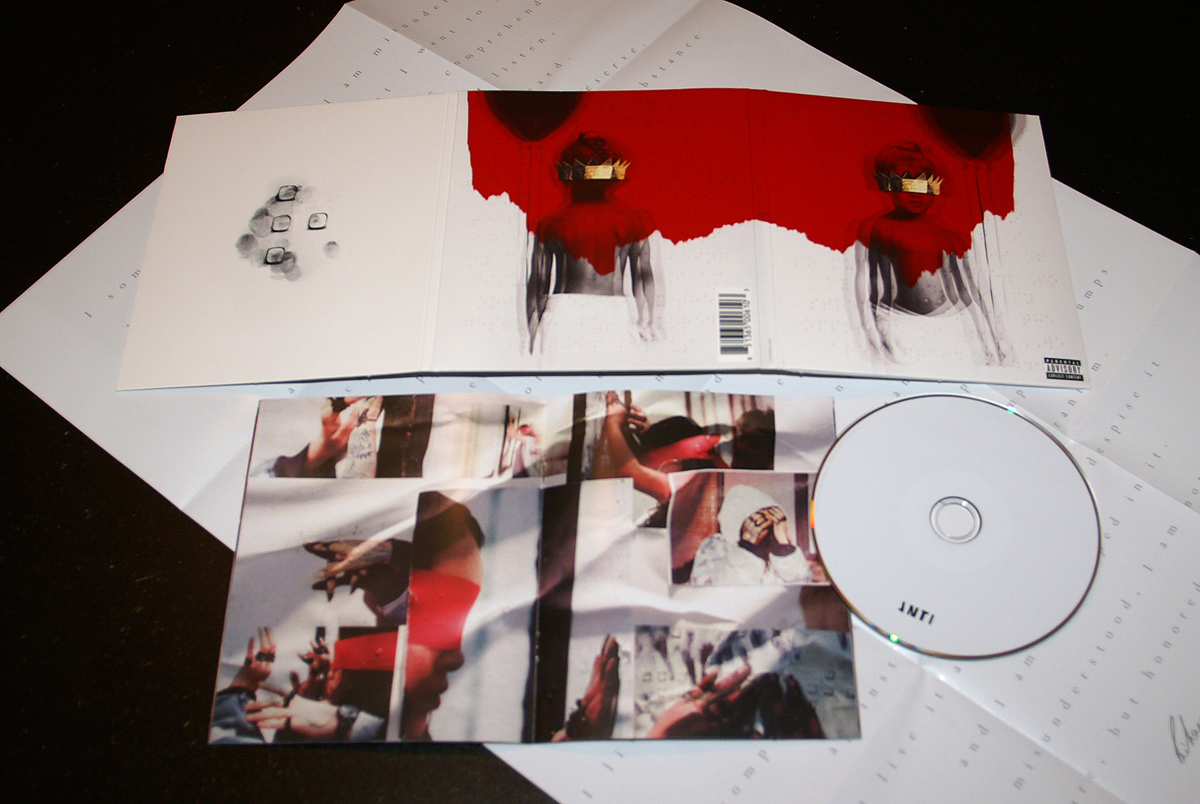

Rihanna's ANTI album is a good and clear example of Digipak's being used in the current music industry. This follows the conventions of a successful and clear to see Digipak as it features roughly 6 panels, along with the content of a signed A3 sheet from Rihanna herself, also along with a photo gallery and the CD itself. Furthermore, it features an iconic front cover despite not having the artist herself featured on the front. What's also very interesting about this album's Digipak is that the title of the album and the name of the artist isn't at all apparent, which shows how unconventional this Digipak is compared to a standard and conventional Digipak.

Lady Gaga - THE FAME MONSTER (2009):


Lady Gaga's THE FAME MONSTER is a good example of a generic Digipak within the pop music industry. It features an iconic head shot image of the artist herself, along with the tracklisting located at the back of the Digipak, the CD located inside of the Digipak and a photo gallery of a photoshoot from the artist to help sell her image. What makes this Digipak feel more exclusive to the consumer, the font on the front cover which reads "Lady Gaga The Fame Monster" is printed in the colour of gold, whereas the general and standard CD case version of the same album is just printed in white. This allows the consumer to then feel more exclusive with the artist due to this reason.

David Guetta - ONE MORE LOVE (2009):
Image result for david guetta digipak


David Guetta's ONE MORE LOVE album is also another example of conventional Digipak. The typography used for the name of the title of the album is almost drawn on with the effect of paint, connoting to the audience and the consumers that there is a laidback and relaxed amount of effort from the artist, but - also connotes artistic. The iconic head shot featured for the front cover is in black and white in contrast to the overflow of paint on the tracklist and the rest of the Digipak.

Green Screen Analysis of Iconic Digipak

Below is a green screen analysis of Lady Gaga's - The Fame Monster digipak. 

Digipak Magazine Analysis


Digipak's often gain publicity through advertisements. This is most commonly done through the feature of magazine adverts for digipak's. Adverts for digipak's are often used to allow the public to familiarise themselves with the new album and to familiarise themselves with the artists. This allows them to know what to be looking out for when getting new music.

Most commonly, magazines advertising new digipak releases traditionally follow the conventions of: featuring the artist of the album, the name of the album, the songs that the public already knows included within the album, the release date of the album, the name of the artist, further information details on the artist such as a website and, platforms in which the album can be listened by. Within this example of a magazine digipak advertisement by Lana Del Rey for her album 'Born To Die', it features all of these conventions. This advertisement features: the artist, the same front cover of the album cover, the name of the artist, the name of the album, the release date, further information details with the website of the artist, the singles that her album includes and the platform of 'Amazon' in which people can hear her new album.

Green Screen Analysis of Iconic Magazine Advert for Digipak's

This is a green screen analysis that I made for Lana Del Rey's digipak magazine advert. 

Wednesday, 7 September 2016

Digipak Template Analysis

As part of my research, I have found a template of a standard Digipak and analysed what features goes where and what they are needed for. 

Tuesday, 6 September 2016

Music Industry Crisis

Music videos are a popular way to relate and express the narrative behind the meaning of a song. The videos relate and have correspondence to the meaning of the songs. However, although music videos have become the norm and are now mandatory for an artist to release, before it became normal, there were a couple of issues present.

The idea that the music industry were in favour more towards white artists for their music videos is something to be argued upon. Back in the early 80's, Michael Jackson released his short feature-film for his classic hit single: 'Thriller'. Before the release of this music video, there was a strong lack of black artists music videos being released and premiered onto the monopolising music video company: MTV. It was almost as if they did everything within their power to avoid featuring black artists on their channel unless they were highly successful and in favour of the mass audience. After seeing the success that Jackson created with his music video, this then pioneered more artists to follow upon his footsteps and achieve similar success, allowing other black and other ethnic minorities to become successful and breakthrough within the music industry and within a company like MTV.

Another music industry crisis I found worthy talking about was the impact of the technology and interference of the internet. With the internet taking the world by the storm, this allowed the public to purchase music online as opposed to leaving their houses to go to a local CD store. But the impact this left within the music industry was that people were purchasing less music from stores, leading to company's like HMV to close down as people could simply buy their music online. Furthermore, with the interference of music, this impacted negatively upon the music industry due to people using piracy on music. People were illegally downloading music from artists, meaning that artists wouldn't essentially make money from the illegal downloads, impacting sales. This also became a problem for artists now as their music often becomes leaked before the anticipated release, which again impacts sales as people hear the music illegally.

Monday, 5 September 2016

Adorno and Horkheimer

Theodor Adorno (a philosopher, sociologist and composer) was born in 1903 - 1969 and was a leading member at the Frankfurt School in Germany, along with Max Horkheimer (a philosopher and sociologist) was born in 1895 - 1973 and was also a member of the Frankfurt School of social research.They were both 2 German theorists who fleed German's during World War II in Geneva and thus moved to New York in 1935. The pair created the book 'The Culture Industry: Enlightenment as Mass Deception' in 1944. Within this book, they both accumulated the theory that pop culture essentially is a commodity and that it is mass produced to the mass public. This can include the forms of films, radios, pop music and music videos as certain idelogies and beliefs/messages are put across (sometimes subliminally) within these various formats to convey a message or culture to the mass audiences. The pair both stated that the the culture industry depends upon the most powerful sectors within the industry. In summary, The Culture Industry essentially is the society within the world which is being taken over and drowned by a society of mass pop-culture and industrialisation. But, instead, isn't being encouraged of freedom and individuality within society.

The Famous quotes, theories and statements upon 'The Culture Theory':
  • "Enthusiastic obedience to the rhythm of the iron system"
  • "The culture industry not so much adapts to the reactions of its customers as it counterfeits them"
  • "Presents men with a model of their culture: the false identity of the general and the particular".